


How do you conjugate regular verbs in Spanish in the present tense?
To conjugate regular verbs in Spanish in the present tense:
Remove the infinitive ending (-ar, -er, -ir).
Keep the verb stem.
Add the correct present tense ending based on the subject pronoun.
Present tense endings:
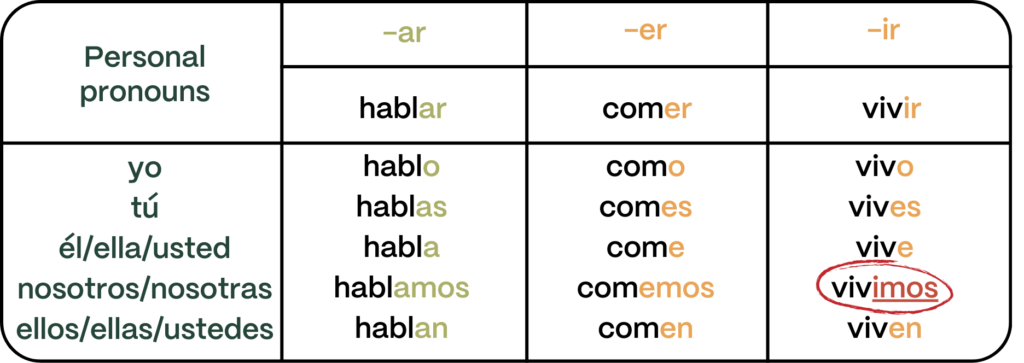
-AR verbs: o, as, a, amos, an
-ER verbs: o, es, e, emos, en
-IR verbs: o, es, e, imos, en
Example: hablar → hablo, hablas, habla, hablamos, hablan
👉 Learning how to conjugate regular verbs in Spanish isn’t just about memorizing endings. It’s about being able to say what you do, what you need, and what matters to you, clearly and confidently.
If you want to speak Spanish with your partner, communicate at work, or feel more independent in daily life, mastering the present tense is your first big step.
So… let’s go step by step!
Keep in mind that in Spanish we only have 3 types of verbs:
So, to conjugate a verb, you need to know its infinitive form. For example:
hablar: to speak / to talk – comer: to eat – vivir: to live
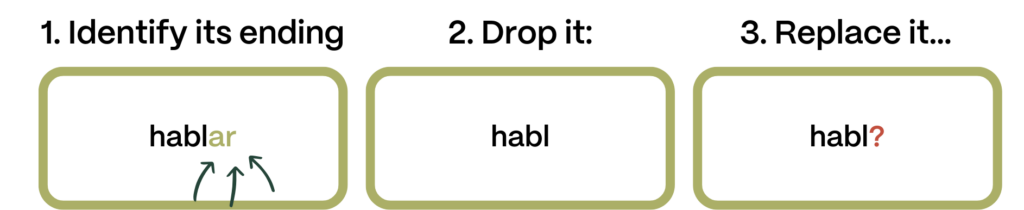
In the next example we’re going to follow these steps:
- identify the verb ending
- Drop it
- Replace it with the right ending according to the subject pronoun
Remember:
Subject pronouns or personal pronouns:Â
I – yo
you (informal)- tú
he / she / you (formal) – él/ella/usted
we – nosotros/nosotras
they /you (plural) – ellos/ellas/ustedes
Then you conjugate each verb according to its ending, like this
Why the Present Tense Matters in Real Life
You use the present tense to:
talk about your job (Trabajo en marketing = I work in marketing)
describe routines (Vivo en MedellÃn = I live in Medellin)
express needs (Necesito ayuda = I need help)
talk about relationships (Mi pareja habla español = my partner speaks Spanish)

Practice Spanish present tense
Do you see the pattern for conjugating verbs? Let’s practice!
Check these Spanish verbs and then choose wisely the right answer in the activity below:
Play this interactive video and fill in the blanks conjugating the infinitive verbs in Spanish present tense
Spanish in context
Now it’s time to learn some useful phrases. Listen and repeat
Struggling to Speak Even If You Know the Rules?
Many adult learners understand verb charts…
But freeze in real conversations.
That’s because confidence doesn’t come from memorizing, it comes from guided practice and real interaction.
Ready to Use the Present Tense in Real Conversations?
In our online Spanish lessons, we focus on helping adult learners speak naturally and confidently, not just memorize grammar.
Â
 Book your free Spanish trial lesson and start using the present tense in real-life conversations from day one.
FAQ
What are the most common regular verbs in Spanish?
Some of the most useful regular verbs are hablar (to speak), trabajar (to work), necesitar (to need), comer (to eat), beber (to drink), vivir (to live), creer (to believe, to think), and escribir (to write).
How do you conjugate regular verbs in the Spanish present tense?
To conjugate regular verbs, remove the infinitive ending (-ar, -er, or -ir) and add the correct ending for the subject pronoun. Each verb group has its own set of endings.
What is the difference between -ar, -er, and -ir verbs?
The main difference is the endings they take when conjugated. For example, hablar (-ar), comer (-er), and vivir (-ir) each follow different conjugation patterns, even though they are all regular verbs.
What should I learn after regular present tense verbs?
Once you’re comfortable with regular verbs, the next step is learning the most common irregular verbs, reflexive verbs, and how to use the present tense naturally in conversations.
Can I practice these verbs with a Spanish teacher?
Yes! If you’d like personalized feedback, conversation practice, and a structured learning plan, you can book a free trial Spanish lesson. During the class, we’ll assess your level and help you build confidence speaking Spanish from day one.


