Spanish Numbers for Beginners: Learn to Count from 0 to 100 Easily

numbers in spanish up to 100

Have you just started learning Spanish? One of the first things you should learn is numbers. You’ll use them every day when introducing yourself, asking someone’s age, telling the time, shopping, ordering food, and talking about prices.


In this lesson, you’ll learn the basics of Spanish numbers and download a free infographic to help you practice.

Why Learn Spanish Numbers up to 100?​

Learning numbers up to 100 helps you communicate in many real-life situations, such as:

✔ Saying your age

✔ Giving your phone

✔ Telling the time

✔ Talking about dates

Spanish Numbers from 0 to 10

NumberSpanish
0cero
1uno
2dos
3tres
4cuatro
5cinco
6seis
7siete
8ocho
9nueve
10diez

💡 Tip: Read these numbers aloud several times. Pronunciation improves with repetition!

Numbers from 11 to 20

These numbers are slightly different because many have unique forms.

  • 11 – once
  • 12 – doce
  • 13 – trece
  • 14 – catorce
  • 15 – quince
  • 16 – dieciséis
  • 17 – diecisiete
  • 18 – dieciocho
  • 19 – diecinueve
  • 20 – veinte

Counting from 21 to 100

After 20, Spanish numbers become much easier because they follow patterns.

  • 21 – veintiuno
  • 25 – veinticinco
  • 30 – treinta
  • 31 – treinta y uno
  • 42 – cuarenta y dos
  • 58 – cincuenta y ocho
  • 76 – setenta y seis
  • 99 – noventa y nueve
  • 100 – cien

Once you know the tens (30, 40, 50, etc.), you can build almost any number.

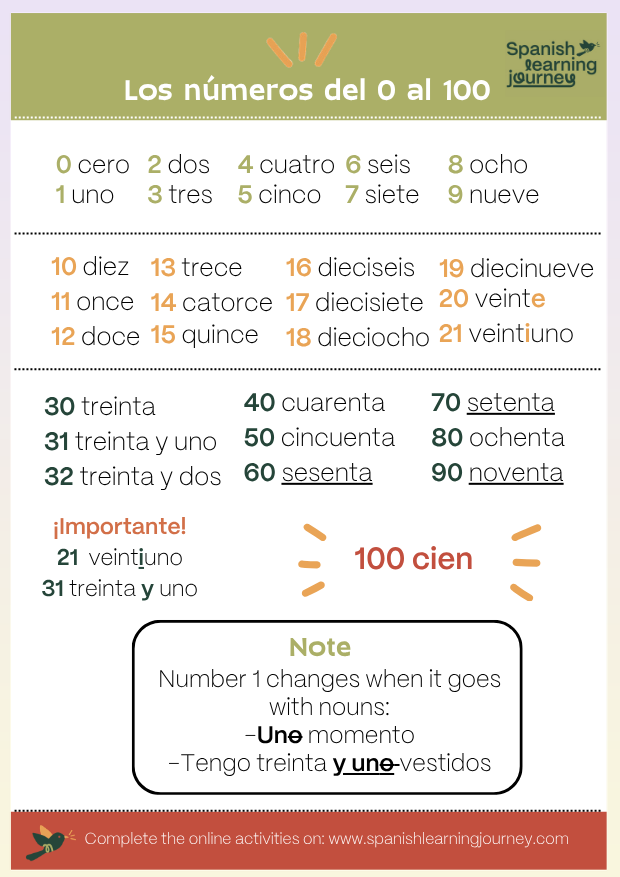
Free Spanish Numbers Infographic

To make learning easier, we’ve created a free Spanish Numbers up to a 100 Infographic.

numbers in spanish up to a hundred

Practice Your Spanish Numbers

Try answering these questions in Spanish.

  1. ¿Cuántos años tienes? (How old are you?)
  2. ¿Cuál es tu número de teléfono? (What’s your phone number?)
  3. ¿Cuántas personas hay en tu familia? (How many people are in your family?

Write your answers in a notebook or say them out loud.

Ready to use the Spanish numbers in context?

In our online Spanish lessons, we focus on helping adult learners speak naturally and confidently, not just memorize grammar.

👉 Book your free Spanish trial lesson and start using the Spanish numbers in real-life conversations from day one.

FAQ

What numbers should beginners learn first?

Start with numbers from 0 to 20. Then learn the tens (30, 40, 50, etc.) and practice combining them.

Not at all! After learning the first twenty numbers, most follow simple patterns that are easy to remember.

Practice a little every day, say the numbers out loud, use flashcards, watch videos, and review visual resources like infographics.

It depends on the conversation. Numbers are essential when shopping at a local market or local stores, or paying at restaurants, and many other everyday situations.

Leave a Comment

Your email address will not be published. Required fields are marked *