
If you’re preparing for your first Spanish class phrases, this post gives the exact phrases students use, the most common things teachers say, and a short sample lesson you can practice before class. Use these lines to feel confident from minute one.
Essential phrases students should know (with translations & usage)
Use these in your first class, say them aloud a few times before the lesson.
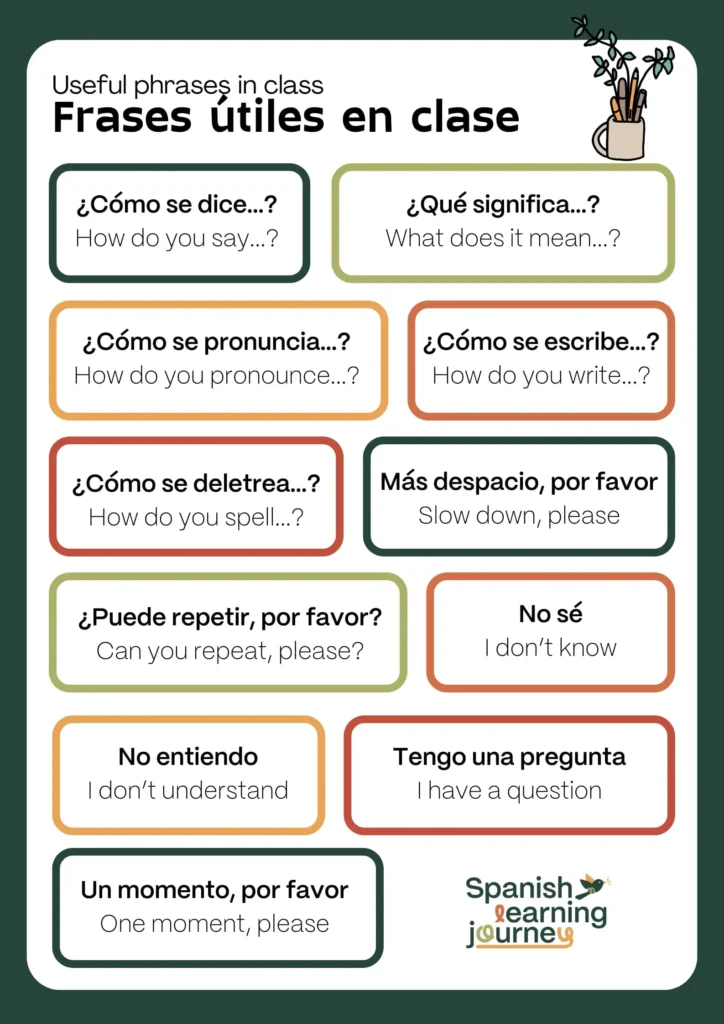
Hola → Hello
Friendly, universal greeting.Me llamo… → My name is…
Usage: Introduce yourself. Me llamo Leonardo.Soy de… → I’m from…
Soy de Estados Unidos / Soy de Colombia.No entiendo → I don’t understand
Polite and useful. Teachers expect this.- No sé → I don’t know
¿Puedes repetir, por favor? → Can you repeat, please?
Usage: when you didn’t understand and want to hear it one more time¿Cómo se dice … en español? → How do you say … in Spanish?
Usage: when you have a word in your native tongue that want to learn in Spanish¿Qué significa …? → What does… mean?
Useful when you see or hear a new word in Spanish.- ¿Cómo se escribe? → How is it written/spelled?
Más despacio, por favor. → Slower, please.
Useful when you struggle understanding what your teacher is saying¿Puedes hablar más despacio? → Can you speak more slowly?
¿Cómo se pronuncia? → How is it pronounced?
Usage: when you read a word and don’t know how it soundsLo siento / Perdón → Sorry / Excuse me
Good for small interruptions or mistakes.- Tengo una pregunta → I have a question
- Un momento, por favor → One moment, please
Gracias / Muchas gracias → Thanks / Thank you very much
Always useful and polite.
Infographic Text | First Spanish Class Phrases for Students
→ Student Phrases
Common teacher phrases (what the teacher will say & how to respond)
Teachers often use set phrases to guide the class. Learning them helps you follow instructions.
- Hoy vamos a practicar… → Today we’re going to practice…
Listen for the lesson goal. - Muy bien / Excelente / Perfecto → Very good / Excellent / Perfect
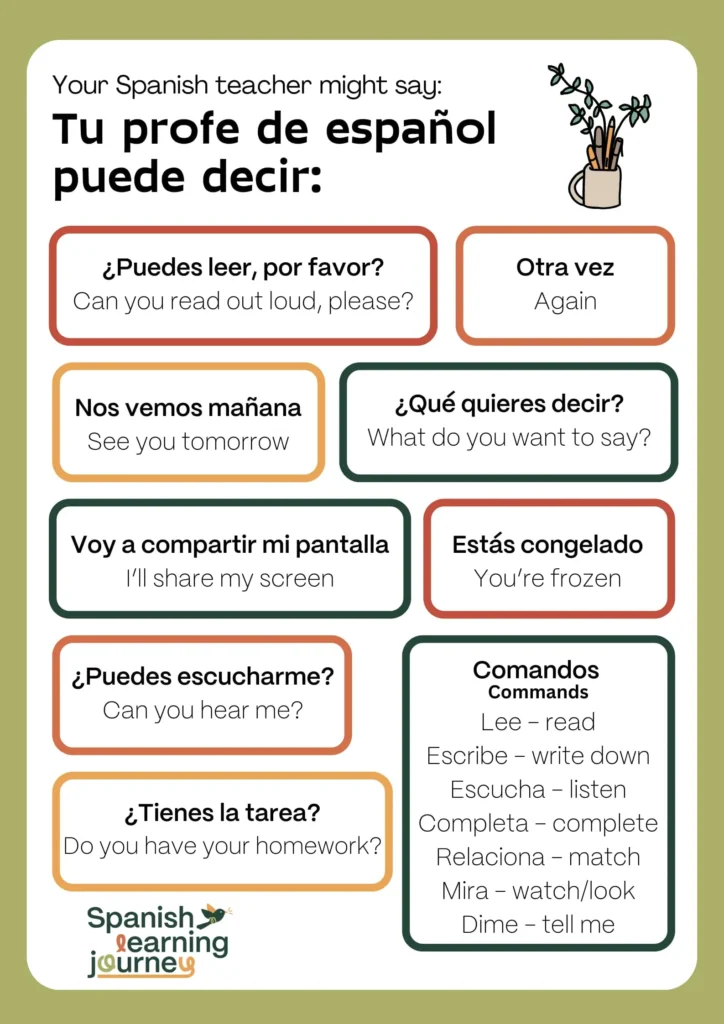
Positive feedback. Smile and keep going! - ¿Puedes leer, por favor? → Can you read aloud, please?
- Otra vez → again
When the teacher wants you to repeat what you just said - ¿Qué quieres decir? → What do you want to say?
When you’re struggling to find the word in Spanish, your teacher will step in and help you - Voy a compartir mi pantalla → I’m going to shar my screen
- ¿Puedes escucharme? → Can you hear me?
- ¿Tienes la tarea? → Do you have the homework?
- ¿Es claro? → Is it clear?
When your teacher wants to know if their explanation was understandable - Estás congelado → You are frozen
Only for online classes - Lee, por favor → read, please
- Repite después de mí → repeat after me
- Escribe → write down
- Escucha → listen
- Completa → complete
- Relaciona → match
- Mira → look
- Dime → tell me
Infographic Text | First Spanish Class Phrases
→ Teacher Phrases
5 quick tips to feel confident on day 1
Bring a notebook and write down phrases the teacher repeats.
Use the phrases above in the first five minutes. It’ll help you to feel more confident to continue using the language.
Don’t be afraid to say No entiendo and ¿Puedes repetir? often.
Record a short audio of yourself and compare with the teacher’s pronunciation.
Practice one phrase per day (e.g., Me llamo… for Day 1).
FAQ
What should I say in my first Spanish class?
Start with simple introductions: Hola, me llamo…, soy d…. Ask ¿Cómo se dice X en español? and use No entiendo if you need slow speech.
How can I ask the teacher to speak slower?
Say: ¿Puedes hablar más despacio, por favor? or Más despacio, por favor.
What does a teacher usually say in the first Spanish lesson?
Teachers often say: Bienvenidos, Repite después de mí, and they ask ¿Preguntas? (questions?)
Is it okay to speak English in my first Spanish class?
Many beginner classes allow English briefly for explanation, but try to use Spanish phrases from day one to build confidence.
 Want to practice these lines with a real teacher? Book a free trial lesson with us and practice using your Spanish in a supportive, friendly environment. We’ll focus on pronunciation, confidence, and real conversation skills.